

The History of Beer III – Medieval Europe 2: Society & Culture
When is a drink not just a drink? When it’s a beer of course. In medieval Europe, beer was everywhere and affected everyone, so let’s start with its nickname – liquid bread.
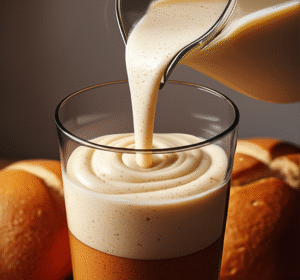
In 14th century England, grains accounted for 80% of the calorific intake of the working class, and much of this would have come from beer. Not only is it a great source of calories, it is also rich in carbohydrates and B vitamins, setting workers up for long days in the field.
Sadly, while beer made for rubbish sandwiches, it made up for it by being very good at keeping people hydrated. “Small beer”, which is low in alcohol was consumed by people of all ages, including children, as it was considered to be safer than drinking water. I still have friends who believe this to be true even with the current, ready availability of potable water. This safety factor is linked more to the production process whereby the boiling of wort would have sterilized the water used rather than the alcohol content of the final product.
Beer was so popular, thanks to its perceived safety, nutritional properties, and yes, taste that as the quality of water decreased due to urbanisation, the consumption of beer increased to levels that modern multinational brewers can only dream of1 . And it wasn’t all “small beer”, people tended to start the day with weaker ales but opted for something stronger with meals or after work.
When we looked at the Celts and Germanic peoples, we saw that beer crossed social thresholds, and this continued to be true in the medieval age. While many nobles and other wealthy people chose to drink wine, viewing it as more prestigious drink, they still drank plenty of beer, especially in Northern Europe. As well as drinking it themselves, larger noble households would have had their own breweries to sate the thirst of their staff.
And so, we find ourselves back to the concept of “liquid bread”. The clergy relied on beer as part of their diet, especially when fasting. And much like today, university students also enjoyed beer. For these lucky students there were even tax exemptions on beer!
Brewsters


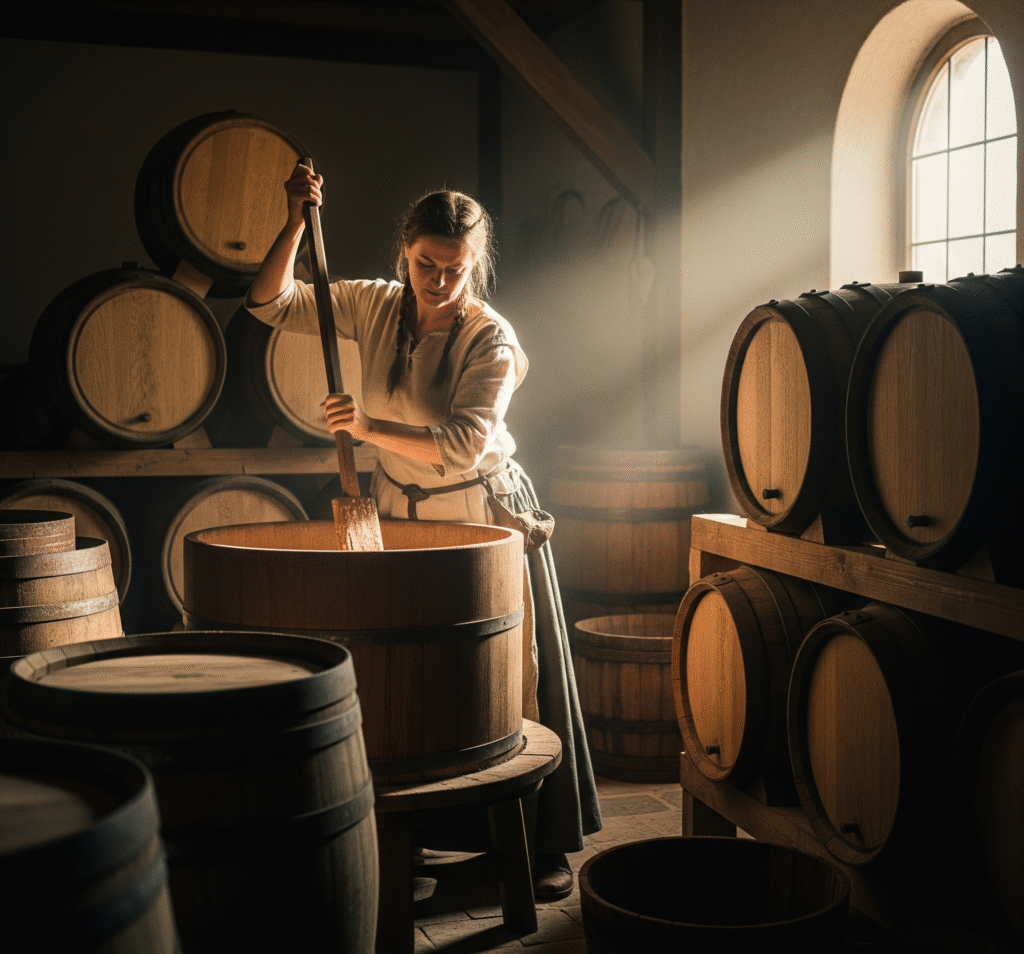
At the start of the medieval period, brewing was the work of women. Known as brewsters or alewives, these amazing ladies brewed ale at home as part of their domestic chores. Not only did they supply their own families, but they also sold beer to their neighbours and the local community, making them a vital part of the economy. Their travails not only allowed them to contribute financially to their families in the case of married women but also gave financial support and independence to single or widowed women.
Unsurprisingly, as the economic potential of beer grew, the role of women was denigrated by men who became increasingly dominant in the industry. Male entrepreneurs and business owners were able to make larger initial investments, purchase more expensive equipment, and had the upper hand as they had greater control of emerging regulations. In addition to wielding their monetary clout, men actively disparaged the alewives in the eyes of the public, making them scapegoats for the problems of excessive alcohol consumption, even branding them as witches. This shift in control highlights a social constant whereby patriarchal societies have endeavoured to control the public and economic roles of women. And on that bombshell, back to the studio let’s head to the pub.
The Birth of the Pub
As well as being the drink that fuelled an age, beer was of great cultural and religious significance. Anywhere where people gathered to interact, celebrate, or worship, beer was to be found.
While the religious monks drank in their monasteries, secular folk would head to the alehouse or tavern. Whether a simple room in an alewife’s home, or a venue specifically opened for the purpose of selling beer, these early pubs served as gathering places where people of different socio-economic levels could gather to catch up, discuss business, listen to music, play games, tell tall tales, and, of course, gossip. Conveniently enough, many also offered lodging for travellers and those who found themselves the worse for wear.
Over time, the permanence of taverns became more fixed, and some catered to different crowds, but they also became associated with societal problems and disorder brought on by gambling and excessive drinking. Inevitably, this led the authorities to attempt to impose regulations on their operations and customers.
It’s Party Time
Copious adjective
co·pi·ous ˈkō-pē-əs
: yielding something abundantly
a copious harvest
copious springs
: plentiful in number
copious references to other writers
: full of thought, information, or matter
… Shakespeare, whose soul was so copious …—Gilbert Highet
: profuse or exuberant in words, expression, or style
a copious talker
: present in large quantity: taking place on a large scale
copious weeping
copious food and drink
If there is a better word to sum up the quantity of alcoholic beverages consumed at medieval events than copious, I don’t know it. There were copious rituals, festivals, and celebrations, both religious and secular, and alcohol was served copiously at them.
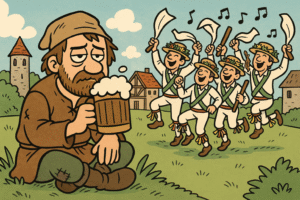
In England, long before the days of the WI, churches held communal events known as parish or church ales to raise funds. These gatherings featured sports, games, music dancing, and copious quantities of ale, not all of which was consumed to numb the mind to the mental horrors of Morris Dancing.
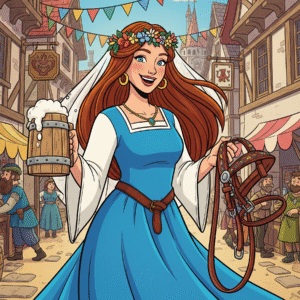
A variety of ales were served at these shindigs, including leet-ale (on manorial court days), lamb-ale (at sheep-shearing), Whitsun-ale (a major seasonal festival), and even the bride-ale (a wedding feast to support the new couple)2, which is the source of the word bridal, which should not be confused with bridle.
Obviously, it wasn’t just the English who linked beer to having a good time. Across mainland Europe, brewing was linked to pagan practices and treated as a gift from the gods. With the rise of Christianity, the church was keen not to alienate people, so many pagan festivals were incorporated into the Christian calendar and different beers were tied to different festivals. The Paulaner monks, brewed stronger beers like Doppelbock for lent to provide more sustenance while fasting, and other beers were brewed and marketed to celebrate the changing of the seasons.

All this just goes to show how important beer was to social cohesion. These events were not solely about alcohol consumption, they strengthened communities, uniting people, supporting institutions, and provided aid to those in need. The involvement of the church legitimised the consumption of beer in a way that was totally at odds with later attitudes born out of temperance movements. In the medieval ages, people didn’t give up beer for lent, they drank stronger beer!
- People in cities in the 16th century drank about 250 [litres] of beer per person per year https://www.ceu.edu/article/2014-06-16/beers-old#:~:text=People%20in%20cities%20in%20the%2016th%20century%20drank%20about%20250%20liters%20of%20beer%20per%20person%20per%20year ↩︎
- https://en.wikipedia.org/wiki/Parish_ale ↩︎


