Chopsticks: How Billions Use Them Daily and yet No one Really Knows What They’re Doing
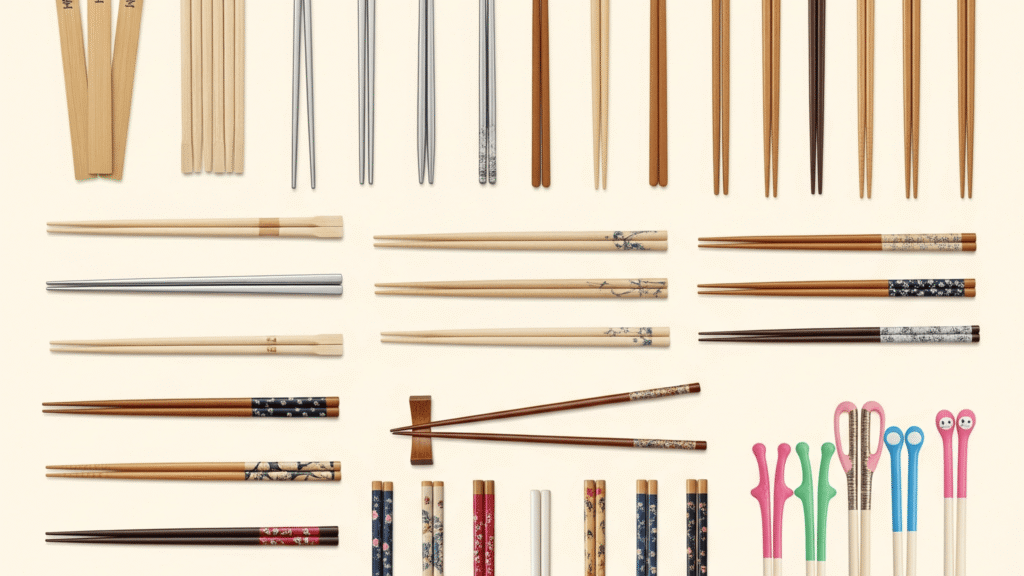
Chopsticks. Utterly simple, maddeningly fiddly, and wielded daily by over two billion people.[1] You’d think we’d have this whole “how to hold them” business down to a science by now — or at the very least, a flowchart. But no. When it comes to the actual mechanics of chopstick grips — the angles, finger positions, and mystical thumb pressures — we’re still largely winging it.
Despite their iconic status in East Asian culture (and on the global food scene), the humble chopsticks’ many grip styles remain shockingly under-documented. Academic papers have traced their 4,000-year history,[2]culinary schools have taught generations the “standard” hold, and anthropologists have waxed lyrical about their cultural symbolism. Yet, somehow, nobody thought to write a user manual that explains why your uncle holds his like a lobster claw, your wife uses a ballet-dancer elegance, and you? Well, let’s just say you get the job done.
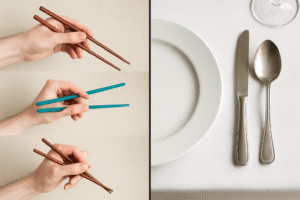
I first learned to use chopsticks as a child — either before or right around my eighth birthday. I remember because that birthday was spent at Mr. Li’s Chinese restaurant in Horsham, and I was gifted a pair of chopsticks by Mr. Li himself. It still amazes me when Taiwanese friends act surprised that a Westerner can wield chopsticks at all. I assumed it was standard practice — like learning to tie your shoelaces, or knowing that “fork and knife” is obviously the wrong way round. (It’s “knife and fork.” Always. This is not up for debate.)
Sure, there are some well-meaning “how to use chopsticks” guides out there. They almost always teach the same grip — the one supposedly endorsed by grandmothers, etiquette experts, and Taiwanese school lunch ladies everywhere. But when it comes to cataloguing the rich diversity of real-world grips — from the accidental to the ancestral — there’s precious little. No taxonomy. No glossary. No comparative studies of “Idling Thumb” versus “Vulcan Salute.” Just parental teachings and YouTube tutorials.
Meanwhile, out in the wild, everyone’s improvising. I once had a friend here in Taiwan — Jimi — a clever, charming guy from a well-to-do family who’d studied abroad and spoke multiple languages. And yet, when it came time to eat? He’d casually put down the chopsticks and dig in with his fingers. Obviously not when eating sauced or communal dishes, but for almost anythingelse. “I can use them,” he’d say, “but why would I bother?” Fair point, really. He had a particular elegance about it, too. Somehow it never looked uncouth when he did it. Just… pragmatic.
On the other end of the spectrum, there’s the peculiar Western instinct to turn chopstick usage into a party trick. Asians do not expect accolades for mastering cutlery, but give a Westerner some bamboo sticks and a bowl of rice, and suddenly it’s the Olympics. I’ve seen people ‘show off’ by lifting individual grains of rice, or perform synchronized peanut routines as if auditioning for Cirque du Soleil. It’s not a performance, folks — it’s lunch.
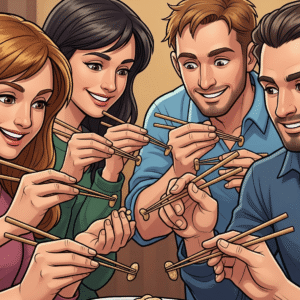
And here’s a surprise: chopsticks aren’t even the default in every part of Asia. When I lived in China, I was startled to discover that for many people — especially students — the real stars of the utensil drawer were the humble spoon or the classic spoon-and-fork combo.[3] Chopsticks were there, of course, but they weren’t always top billing. Was it because spoons are easier to clean in a shared dorm sink? Or just more sensible when eating noodles swimming in broth? One thing’s for sure: no matter how good your grip is, you’re not eating soup with a pair of sticks. Not unless you’re playing the long game in some kind of sadistic patience challenge.
Enter the internet’s unsung heroes: niche researchers and culinary oddballs who’ve decided enough is enough. One standout is Marcosticks.org (yes, it’s real), where a modern-day Linnaeus of the chopstick world has taken it upon himself to name and classify dozens of grip styles.[4] “Chicken Claws.” “Slacker’s Pinch.” “Sideways Scholar.” These are not just excellent band names, but actual terms used to describe the wonderfully weird ways we hold our sticks. Some taxonomies even rank grips based on whether your thumb is “idling” or “engaged,” which, frankly, is more personality insight than I ever expected from a set of eating irons.
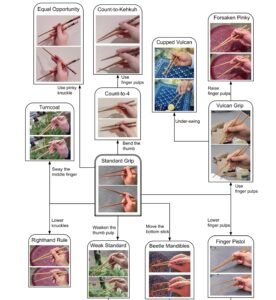
Meanwhile, the academic world — bless it — has dipped its toes in, mostly through studies on biomechanics, occupational therapy, and child development.[5] These are the people measuring EMG signals in your forearm while you fish for tofu. Admirable work, yes, but often a bit dry and rather… pincer-focused. Most research papers lump grips into vague categories like “scissor-type” or “pincer-type,” which tells us about as much as “fork” versus “spoon” in describing Western table manners.
And speaking of forks — why, oh why, do so many Americans feel the need to chop everything into toddler-friendly chunks before shovelling it in with just a fork? Watching it happen is like witnessing a betrayal of cutlery’s higher purpose. At least in East Asia, food arrives pre-cut, elegantly portioned, and begging for a bit of poise. Chopsticks, if nothing else, insist on a slower, more restrained dining pace — rice and noodles notwithstanding.
And so, for thousands of years, chopstick technique has been passed down like a secret handshake: learned at family dinner tables, whispered over hot pot, or just copied from the person sitting next to you. It’s an oral tradition — which sounds romantic, until you realise it’s also why no one can agree whether you’re a genius innovator or just bad at eating dumplings.
It’s a paradox, really: the world’s most commonly used eating tool is also one of the least formally understood. But thanks to the rising tide of online encyclopaedias and amateur ethnographers with nothing better to do during lunch, the tide may be turning.
[1] Estimated chopstick usage exceeds 2 billion people daily, including populations in China, Japan, Korea, Taiwan, Vietnam, and global diaspora. China alone discards about 45 billion pairs of disposable chopsticks annually https://recipes.howstuffworks.com/chopsticks.htm?utm_source=chatgpt.com#:~:text=More%20than%2020%20percent%20of%20the%20world’s%20population%20relies%20on%20chopsticks%20for%20eating.%20China%20alone%20goes%20through%2045%20billion%20disposable%20pairs%20per%20year.%20
[2] The origin of chopsticks can be traced back to China around 1200 BCE. See: Q. Edward Wang, Chopsticks: A Cultural and Culinary History, Cambridge University Press, 2015.
[3] In parts of southern China and Southeast Asia, particularly among students and diners in casual settings like cafeterias, it’s common to use spoon or spoon-and-fork combos. Regional etiquette guides note that the spoon is often used in the right hand, with the fork merely pushing food—especially rice or soup—onto it
[4] Marcosticks.org is a real website documenting dozens of grip styles, complete with whimsical illustrations and classification systems.
[5] See Wang, Yueh-Ling, et al. “Development of a novel training chopstick and its effect on upper limb function in children.” Journal of Motor Behavior, 2012.
P.S. We’ll save the real discussion of chopsticks etiquette for another day. It may take years and millions of lives to understand.