
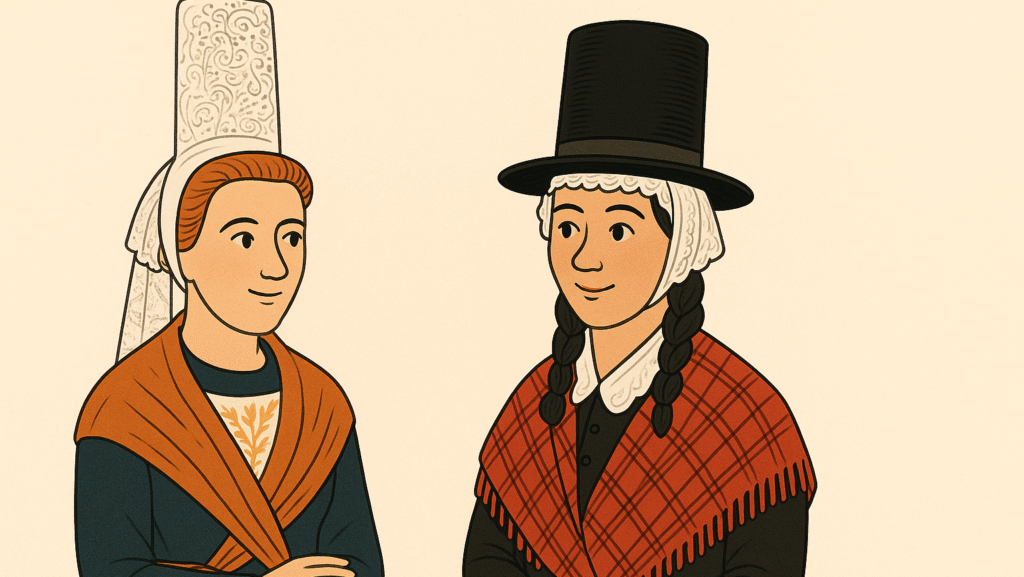
Separated at Birth — Welsh & Breton
“Cymraeg” and “Brezhoneg” may live on opposite shores of the Channel, but they share ancient DNA. And headwear.
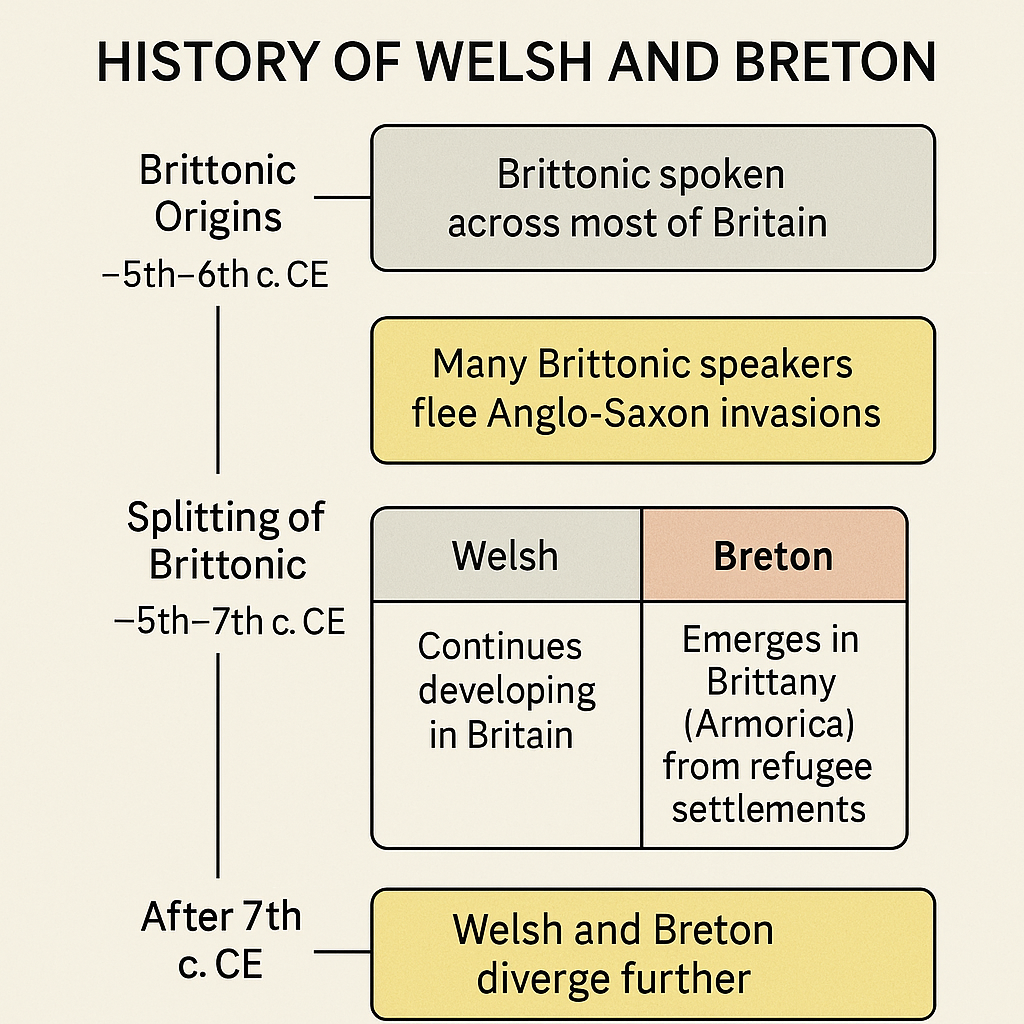
Welsh and Breton are the only surviving daughters of Brittonic, the Celtic language once spoken across much of Roman and post-Roman Britain. As Anglo-Saxon pressure mounted in the 5th and 6th centuries CE, many Brittonic speakers fled to Armorica (modern Brittany), taking their words, gods, and livestock with them. The result? A new dialect that grew up on foreign soil — Breton — while back home, Welsh held its ground in the west.
The languages remain cousins: they both use consonant mutations, love a good verb-noun hybrid, and sound like poetry even when you’re just asking for tea. But they’ve led very different lives. Welsh has been resurgent in schools and signage; Breton has fought an uphill battle against French centralism and now survives mainly in the west of Brittany, and among determined revivalists.
Mini Timeline: History of Welsh and Breton
• 5th–6th c. CE: Brittonic spoken widely in Britain
• Post-Roman era: Refugees bring Brittonic to Brittany
• 5th–7th c. CE: Welsh and Breton diverge
• After 7th c. CE: Languages evolve independently
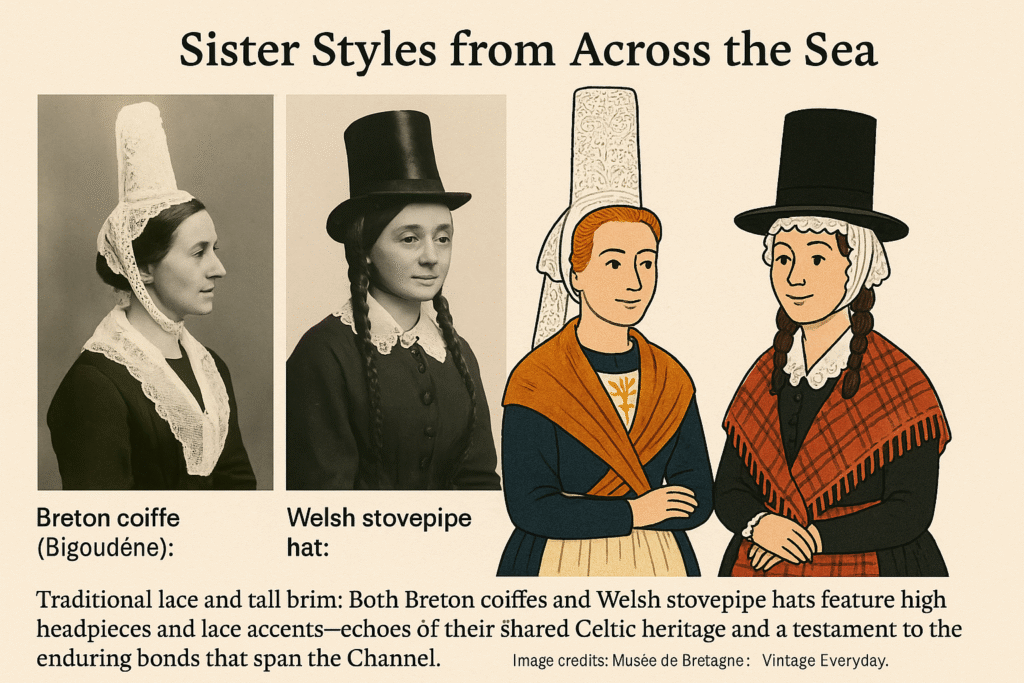
Sister Styles from Across the Sea
It’s not just in language that you can spot the family resemblance. Traditional folk dress in both cultures features elaborate women’s headwear: the lacey Breton coiffe and the tall Welsh stovepipe hat. Though developed independently, these iconic styles speak to shared aesthetics — and perhaps a shared flair for dramatic millinery.
Quick Fact
Despite their common roots, Welsh and Breton are not mutually intelligible — though both have familiar words like tad (“father”) and brawd/breur (“brother”), and a musical quality that makes either one a joy to hear, even if you don’t understand a word.
References
1. Koch, John T. *Celtic Culture: A Historical Encyclopedia*. ABC-CLIO, 2006.
2. Ball, Martin J., and Fife, James (eds). *The Celtic Languages*. Routledge, 2009.
3. “Welsh Language Strategy 2012–17.” Welsh Government.
4. Hornsby, Michael. *Revitalizing Minority Languages: New Speakers of Breton, Yiddish and Lemko*. Palgrave Macmillan, 2015.
5. UNESCO Atlas of the World’s Languages in Danger. Entry: Breton.