
Potato: A Deep-Rooted Word1
“Rincewind had eaten in many countries on the Disc, and sometimes he’d been able to complete an entire meal before having to run away. And they’d always lacked something. Oh, people did great things with spices and olives and yams and rice and whatnot, but what he’d come to crave was the humble potato.
Time was when a plate of mash or chips would have been his for the asking. All he’d needed to do was wander down to the kitchens and ask. Food was always available for the asking at Unseen University, you could always say that for the place, even if you said it with your mouth full. And, ridiculous though it sounded now, he’d hardly ever done that. The dish of potatoes’d come past at mealtimes and he’d probably have a spoonful but, sometimes, he wouldn’t! He’d… let… the… dish… go… by. He’d have rice instead. Rice! All very nutritious in its way, but basically only grown where potatoes would’ve floated to the surface.”2
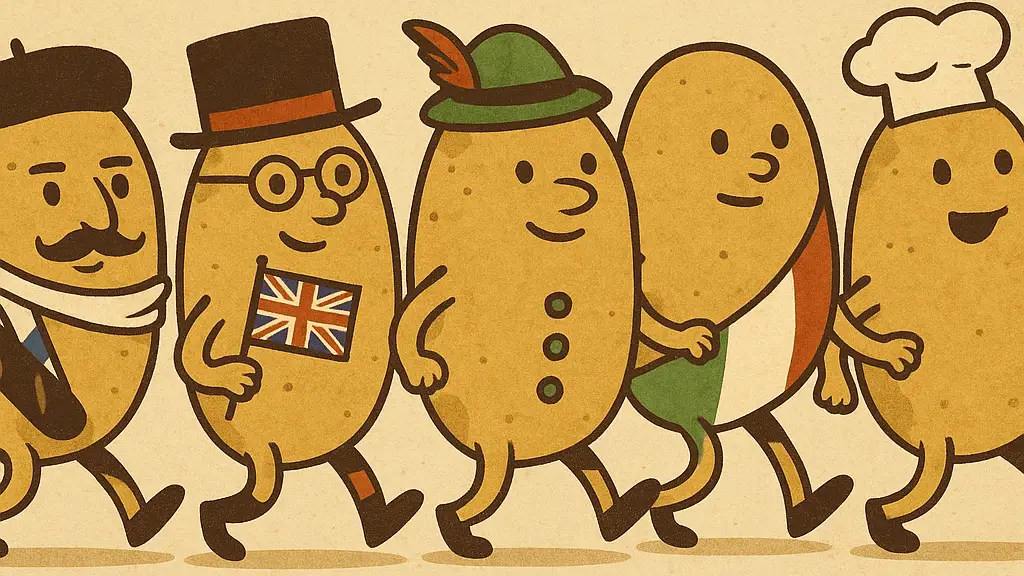
The humble potato – knobbly, versatile, and sometimes suspiciously shaped like a politician – is far more than just something to mash, fry, or boil.
A Brief History of Potatoes
Before we get to the linguistics of potatoes, we’re going to have a quick look at their tubers history. First domesticated high in the Andes between 8000 and 5000 BC, they have since rolled their way across the globe and into the hearts (and stomachs) of nearly every culture. From peasant fields to royal kitchens, they’ve been misunderstood, misnamed, mythologised, and mashed into countless forms. And just as no two fries are quite alike, the words for “potato” tell a surprisingly rich story of travel, confusion, and linguistic evolution.
The potato’s journey begins in what is now southern Peru and northwestern Bolivia, where Indigenous peoples like the Inca and Mapuche cultivated it for centuries before Europeans ever set foot on the continent. Archaeological remains from Ancón, Peru date back to 2500 BC, underscoring the tuber’s deep local roots. Maize might have hogged the limelight in the Americas, but in higher altitudes where corn sulked and refused to ripen, potatoes thrived.

In 1536, Spanish conquistadors bumped into discovered these humble tubers and brought them back to Europe — somewhat begrudgingly. Europeans, ever suspicious of things that looked like poisonous nightshades, initially spurned the strange underground vegetable. Sir Walter Raleigh is said to have introduced them to Ireland in 1589, but their real rise didn’t occur until the 18th century.
It underpinned the Industrial Revolution, fed Napoleon’s armies, and helped fuel Europe’s population boom. King Frederick the Great of Prussia even encouraged his subjects to plant them, earning the (possibly apocryphal) nickname Kartoffelkönig (Potato King). By the 19th century, the potato had gone global: popular in China by the end of the Ming dynasty, a staple in wartime Africa, and served in the White House courtesy of, if not actually by, Thomas Jefferson.
The Tower of Tuber Babble: Potatoes Around the World
As potatoes spread, so did the confusion — not just about what they were, but what to call them. The naming conventions for this single vegetable are a linguistic garden of earthly delights.
The English word potato comes from Spanish patata, which itself merges two sources: the Taíno word batata (originally referring to the sweet potato), and papa—the Quechua word for the Andean potato. In Spain, patata stuck, but in most of Latin America, the original Quechua papa is still king.

English, ever resourceful, also coined “spud,” possibly from a short digging tool, or perhaps (less convincingly) from an anti-potato activist group called SPUD — The Society for the Prevention of an Unwholesome Diet. If the Internet had existed when this sort of nonsense was a popular myth, we’d have rabid keyboard warriors declaring that only the anti-woke agenda by the lamestream media is covering up this evil, leftie cult and that we should do our own research on social media where our Doreen’s cousin saw a TikTok exposing the lies of Big Potato.
But, across the globe, not everyone followed the same rules and the potato’s name reveals much about how different cultures first encountered the plant—or what they thought it resembled.
Many European languages adopted some variation of the concept “earth apple.” In French, it’s pomme de terre; in Swiss German and Austrian dialects, it’s Herdöpfel or Erdäpfel. Dutch and Afrikaans offer aardappelor aartappel. Persian has سیب زمینی (sīb zamīnī), and Hebrew has תפוח אדמה (tapuach adamah), both meaning “earth apple” or “apple of the land.” These terms reveal an old-world habit of calling anything round and edible an apple — pomum in Latin simply meant “fruit.”
The Germans threw a different tuber into the mix: standard German uses Kartoffel, which evolved from Tartüffel (a diminutive of the Italian tartufo — truffle). Apparently, the early spud reminded someone of a fungus.
The Slavic languages took a cue from the German “Grundbirne” (ground pear). Hence Macedonian and Serbian have krompir, Polish has kartofel (and regional pyra), and Romanian has cartof or dialectal variations like croampă. Hungarian, ever inventive, says krumpli or burgonya, the latter from the French region of Bourgogne.
The Scandinavian languages often used variants like jordäpple or jordeple — again, “earth apple.” Finnish, however, breaks with tradition and gives us peruna, which may come from an older Swedish dialect for pear.
In India and surrounding regions, the potato is known as aloo or alu, derived from the Sanskrit ālu — originally referring to elephant foot yam (Amorphophallus paeoniifolius). When potatoes came along, they simply slid into the yam’s old linguistic shoes, and yes, technically this does mean that when you eat aloo gobi (aloo = potato, gobi = cauliflower) you are eating a dish named for a yam that isn’t there, the ghost of the yam that was.
And so, to Chinese and a wee spot of confusion. In Chinese Chinese, the potato is most commonly known as 土豆 (tǔdòu), literally “earth bean.” This naming convention arose during the late Qing dynasty when the crop became widely adopted, particularly in northern and western provinces. It’s a logical name: it grows underground, it’s starchy like a legume, and well, it looks a bit like a fat bean. In historical texts, though, tǔdòu could refer to other underground crops too, such as peanuts, which leads us to the heart of the confusion…
In Taiwanese Chinese, potatoes are called 馬鈴薯 (mǎlíngshǔ), a term borrowed from the Japanese jagaimo3, itself a contraction of ジャガタライモ (jagataraimo), meaning “Jakarta tuber” — a reference to its path into Japan via Southeast Asia. The word 馬鈴 (mǎlíng) literally means “horse bell,” and while no one is quite sure how that got attached to the spud, the term 馬鈴薯 is now the standard across Taiwan. Meanwhile, tǔdòu (土豆) in Taiwan still means peanut, as it did in many dialects prior to the 20th century.
Cue the anecdote…
The year is 2001, a new millennium has started, and I have just moved to Taiwan, ostensibly to learn Chinese but really to be with a Taiwanese girl I had met when I lived in China. We moved into an apartment in Banqiao in what is now called New Taipei City (新北市) but at the time was known as Taipei county (台北縣) and all was well until one fateful day I decided to cook dinner.
Armed with a scant knowledge of Chinese that I had gleaned whilst living in Shijiazhuang (石家莊), I went to the local supermarket to buy ingredients, including potatoes. I could not find the potatoes, I searched for the potatoes, I hunted for the potatoes, yet still they eluded me, and then it happened, a store assistant asked what I was looking for. Luckily for me, I knew the Chinese for potatoes so I boldly told her that I wanted to buy tǔdòu (土豆). She asked how many and I replied four. She looked at me, at first in confusion, and then a look of understanding crept across her face as she realised… she was talking to a moron. Now the confusion was mine and I did not buy any potatoes.
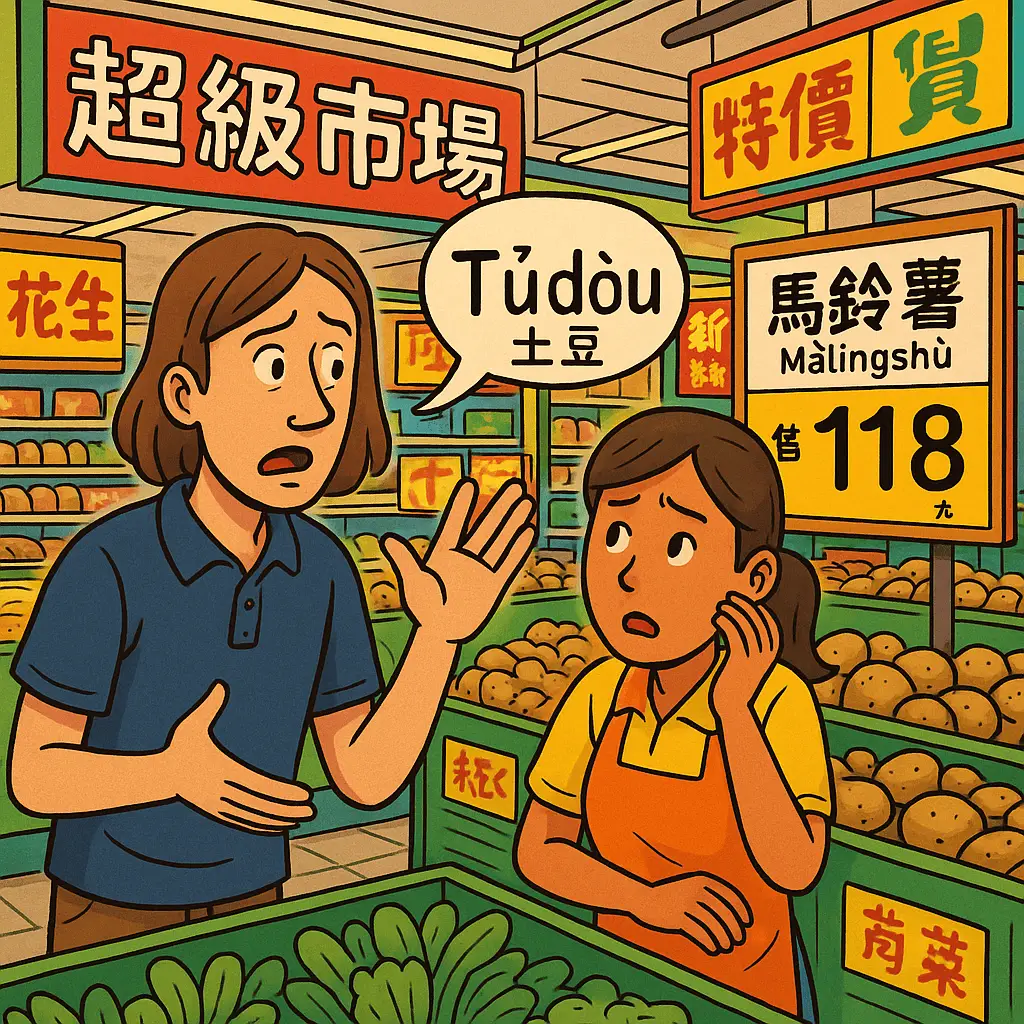
That evening, I recounted the tale to my girlfriend. She laughed and pointed out that while potatoes may be called tǔdòu in China, in Taiwan they are mǎlíngshǔ (馬鈴薯), the term tǔdòu in Taiwan typically means peanuts so it was no wonder that the store assistant was puzzled by the idiot who was trying to buy four peanuts!
Historically matters can become even more confusing. When potatoes first came on the scene, they were sometimes known as 番薯 (fānshǔ) which literally means “barbarian tuber” or “foreign yam” as 番 (fān) was typically used in imperial China to describe things — and people — from non-Chinese lands. It often carried a connotation of “uncivilised” or simply “foreign.” Today in Taiwan and some southern parts of China, while fānshǔ is most commonly used to refer to sweet potatoes— not regular potatoes— it still reflects that early foreign tubers (whether Andean or American) were all initially seen as “barbarian imports.”
And then we have 洋芋 (yángyù). 洋 (yáng) means “ocean” or “foreign,” often used to describe things that came from across the seas and芋 (yù) normally means taro, so 洋芋 = “foreign taro.”
This is a common term for potato in parts of China, like the northwest, and is also used in Taiwan — particularly in compound words like 洋芋片 (yángyù piàn, potato chips).

The Naming of Potato Dishes:
Potatoes have become arguably the most shape-shifting ingredient on earth; there’s a potato dish for every occasion and some wonderful names to go with them.
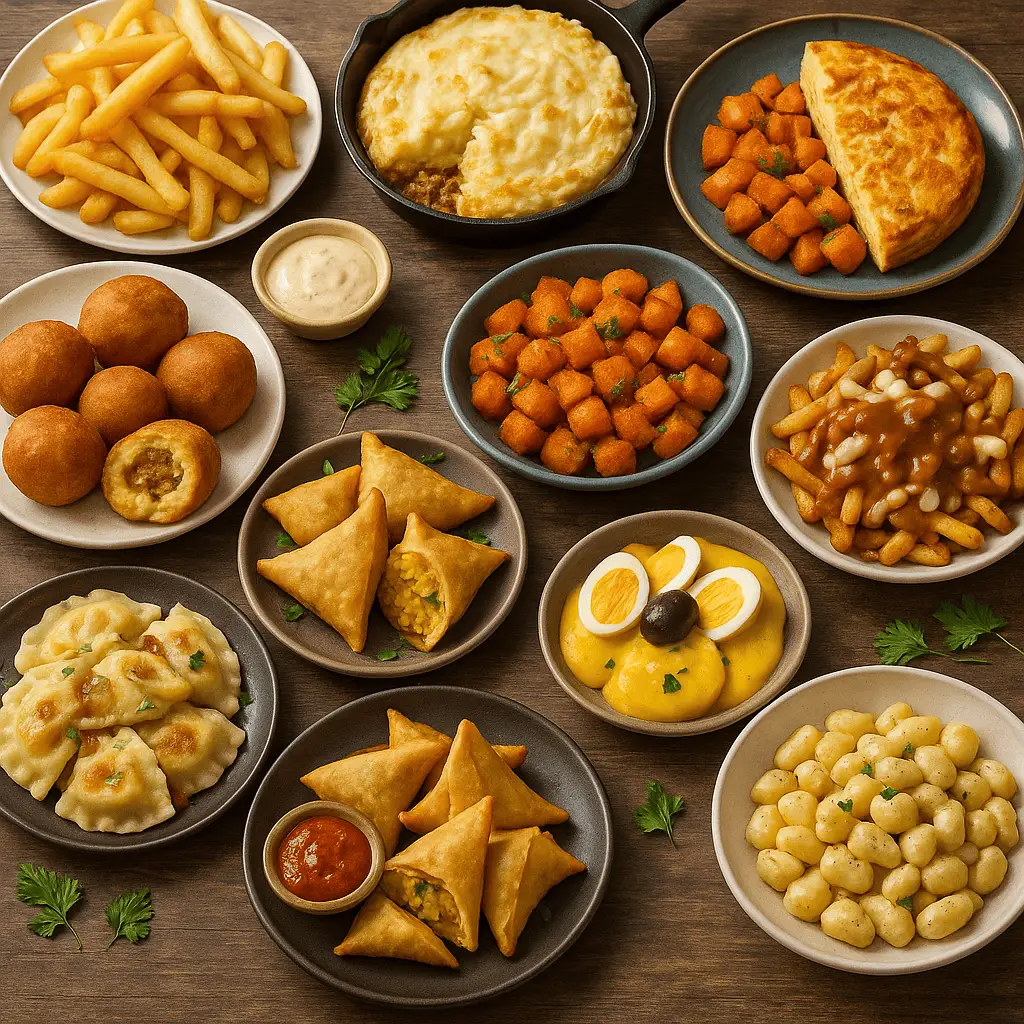
In Europe, we get Belgian frites, French gratin, Irish colcannon, Spanish tortilla de patata, and Italian gnocchi. Germany offers bratkartoffeln and kartoffelsalat. Lithuania gives us cepelinai — zeppelin-shaped dumplings. But these are nothing compared to Brændende Kærlighed (Danish) meaning “Burning Love”, or Janssons frestelse (Swedish) which translates as Jansson’s Temptation and is typically served at Christmas.
While the British gave us Shepherd’s Pie, in France Antoine-Augustin Parmentier, an 18th-century pharmacist and precursor to modern influencers and PR flacks, campaigned tirelessly to popularise the potato by hosting high-society dinners highlighting their charm and even gifting their blossoms to royalty, gave us Hachis Parmentier.
In the Americas there’s poutine in Canada, papas rellenas in Colombia, funeral potatoes in the U.S. — named for where it is typically served, not what it typically leads to — and papas a la Huancaína in Peru.
In Peru, where our tale began you can find Wira pasña and Puka Ñawi Pasña4, “fat whore” and “red-eyed whore woman” respectively, although the meanings of these names is not normally brought to the attention of tourists!
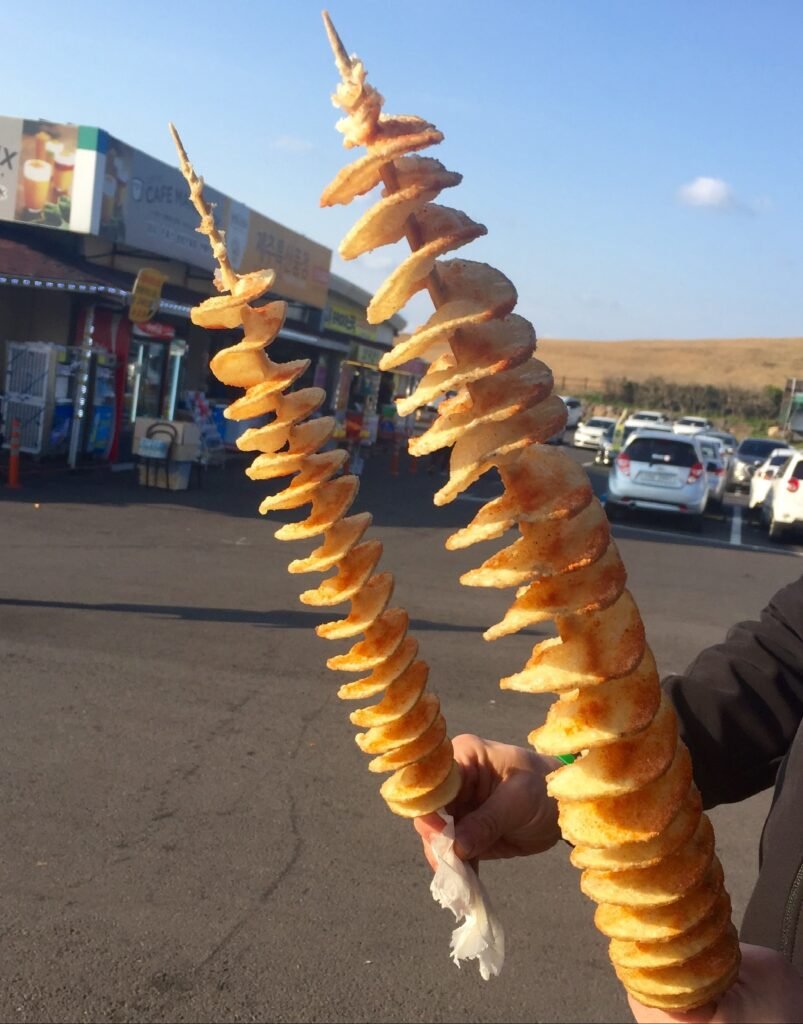
In Asia, potatoes pop up in Indian samosas, aloo paratha, and saag aloo as well as China’s stir-fried tǔdòusī (土豆絲) and in Korea’s gamja-tang (감자탕) and hoeori gamja (회오리 감자) Tornado Potatoes.
From Inca fields to instant mash, the potato has gone places — linguistically, culturally, and culinarily. Its names tell stories of empire and error, translation and transformation. Whether it’s an earth apple, a ground bean, or a tuber that causes confusion at a Banqiao supermarket, the potato proves that even something humble can be gloriously complicated.
So next time you bite into a fry or mash your mash, take a moment to appreciate the linguistic labyrinth of the potato.
- They’re only going to get worse, so dig in for the long haul ↩︎
- Pratchett, T., The Last Continent ↩︎
- Taiwan’s language and culture were heavily influenced by the Japanese as a result of Japan’s 50-year rule of Taiwan starting in 1895. ↩︎
- Gutiérrez-Gómez E, Moscoso-Paucarchuco KM, Luján-Pérez D, Aspur-Barrientos JC and Quispe-Medina ER (2024) The native potato, a symbol of macho expression in the Quechua culture of Peru. Front. Sociol. 8:1268445. doi: 10.3389/fsoc.2023.1268445 ↩︎
- https://www.flickr.com/photos/anokarina/25397239853/ ↩︎
P.S. Still not satisfied? The British also gave us the crisp sandwich. See, British food and its nomenclature really is better than you’ve been led to believe!
P.P.S. And of course, you can drink them too: vodka, poitín, and other spirits owe their clarity (and kick) to the humble potato.


